For Mira Klein, it was a dream come true.
Having worked at many neighborhood coffee shops, Klein had seen how valuable these spaces are as a place for people to gather and connect – and she longed to bridge this value she saw among customers with her experience as a worker and her desire for more emphasis on relationships and agency in the workplace.
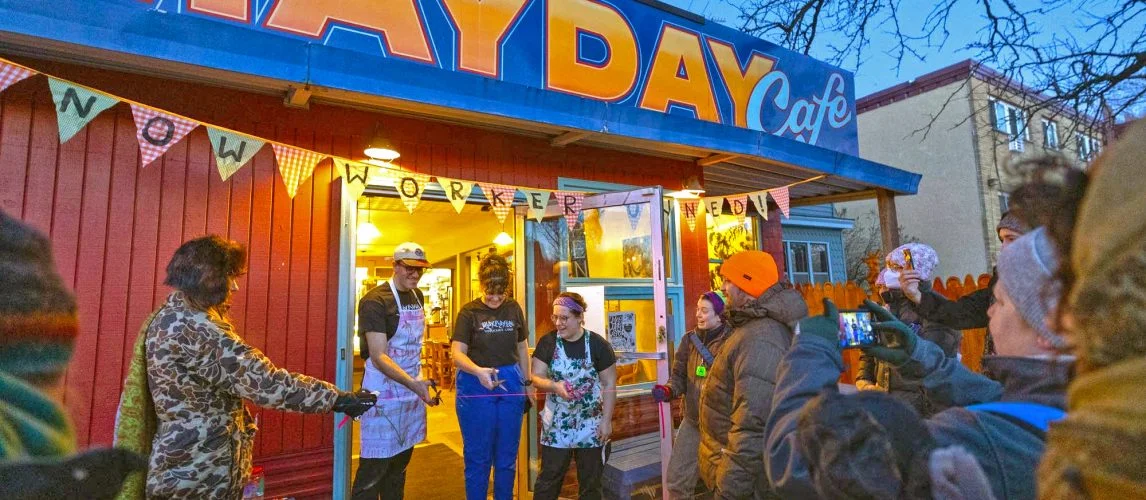
A year after she started as a barista at May Day Cafe in 2022, the cafe’s long-time owner announced he was selling the South Minneapolis mainstay. That opened the door for Klein and other employees to transition May Day Cafe from a sole proprietor to a worker-owned cooperative.
“It’s a dream to be part of a world-building project like this,” Klein said. “I have a real sense of purpose, knowing I’m contributing to something that reflects the world I want to be a part of.”
Navigating a system that wasn’t design for shared ownership
But world-building often requires structures and solutions that don’t fit with the status quo. That’s the case for many shared ownership models, like worker cooperatives. The May Day worker-owners were supported by an outpouring of community generosity, raising $105,000 through local donations. But that wasn’t enough to finance the purchase of the building and resources necessary to continue the business—and getting those dollars was beyond the expertise of the workers who came together to form the coop.
“The timeline of finance is so different than the speed of building a cooperative which is this deep, intimate endeavor where a group of people are taking on a huge risk together all while stepping into totally new roles and decision-making processes and forms of knowledge,” Klein recalled. “We were trying to slow down to figure out how to run a business together and that was in tension with the speed we had to move to get the financing lined up.”
“I remember someone saying, ‘the numbers are so big that they feel unreal,’” she said. “We were talking about hundreds of thousands of dollars and it was hard to even wrap our brains around. The majority of people in this project come from working-class or middle-class backgrounds and nobody owns property so there was a sort of disbelief in it all.”
For MCCD, bridging the gap between aspiration and access is at the heart of what we do. From affordable housing to small business development, we advance policies and provide resources to promote inclusive economic growth and foster generative, long-term community benefit. One way we do that is through lending and technical assistance for shared ownership endeavors—like May Day Cafe.
“Too many Minnesotans have never had equitable access to asset-building opportunities and capital to finance their dreams. With rising inequality, a massive wave of business ownership transitions on the horizon, and long-standing racial and economic disparities, we need bold, systemic solutions that root wealth and power in communities. Shared ownership models offer a proven, culturally grounded pathway to generative economic development—but these models often face unique barriers to financing.”-Electra Skrzydlewski, MCCD Director of Shared Ownership
A community effort to fund the conversion
To address those barriers, MCCD worked with organizational partners and legislative champions to pass a pilot Community Wealth Building Program with the explicit goal of directing state funds to support worker cooperatives and other shared ownership enterprises. The program was received with strong interest and support from lawmakers and resulted in $3 million in funding in 2024. In partnership with the Minnesota Department of Employment and Economic Development, MCCD created the Shared Ownership Loan Fund, providing flexible, low-interest capital for startup, conversion, and growth financing for Minnesota businesses that are at least 51% owned by people who are Black, Indigenous, People of Color, immigrants, low-income, women, veterans, people with disabilities, or those serving underinvested geographic areas.
As a consortium, MCCD doesn’t just advocate for solutions that benefit the community development field and its members, but also works in deep partnership with a wide network of organizations that share resources and lend their expertise to small businesses and entrepreneurial groups. For the May Day Cafe Workers Cooperative project, multiple organizations collaborated to put the pieces together. On the technical assistance side, Nexus Community Partners and Platform CRE provided guidance on employee ownership conversions, real estate acquisitions, and shared ownership business models. On the financing side, MCCD and two of our long-time partners—Shared Capital Cooperative and the City of Minneapolis Community Planning and and Economic Development (CPED) Department—were able to bring more than $670,000 in capital to the project.
For Klein and the other worker-owners, there was a big learning curve around understanding—let alone making a collective decision— around the project financing. “The challenging part of this was not knowing the scope of what it would look like but being aware that this is not a traditional deal,” she said. “Everyone was reflecting back to us, ‘If it feels complicated, it’s because it is!’ I was shocked when all the lenders were on a call together the week of the closing and there were 15 people—12 of whom I’d never heard of or met!”
At MCCD, we know how powerful it can be for borrowers to realize how many people are quietly working on their behalf—that newfound sense of shared investment is a striking reminder that this work isn’t just transactional; it’s relational.
One of the key lenders was City of Minneapolis CPED. Becky Shaw, a Senior Economic Development Specialist, explained that the city’s goal is to create tools to make it more cost-effective for small businesses to launch and operate in Minneapolis — and to bridge gaps to make business development more equitable for historically marginalized enterprises.
“With our programs, there’s intentional inclusion of cooperatives to make sure we’re investing in and committed to other business models that may have been economically disadvantaged, to make sure they have the same financing tools or access to capital.”-Becky Shaw, Senior Economic Development Specialist, City of Minneapolis Community Planning and and Economic Development (CPED) Department
For instance, while the federal Small Business Administration provides low-interest loans that many entrepreneurs rely on, those products don’t work for cooperatives due to the SBA’s personal guarantee requirement. Without those constraints, the City was able to provide a 2% loan of $75,000 to finance a portion of the acquisition costs, and an additional $130,000 Great Streets loan to finance a discrete project gap.
“But I don’t have the capability to do this myself,” Shaw emphasized. “I rely on Shared Capital and Nexus and MCCD to pull all the information together for me. And the city is not a direct lender; all our loan programs are participation based, so I need someone to put the loan structure together and collect payments.”
Shared Capital Cooperative has been putting together these types of loans since its inception—in direct response to the challenges Shaw articulated. “Food co-ops in the late 1960s and 70s struggled to get financing and pooled their resources for micro loans,” said Roderick McCulloch, a loan officer. “Shared Capital has lent more than $70 million in 1,000 loans in 45 years. We’re one of the very small number of Community Development Financial Institutions that work exclusively with co-ops and are a co-op ourselves.”
Because of their structure and the businesses they serve, the way they work is dramatically different from a commercial bank.
“We don’t typically rely on personal guarantees; we’re looking at the capacity of a group rather than an individual sole proprietor, including who amongst the core steering committee or founding members is going to have the skill sets to maintain and operate this business. We look at how organized they are, how well developed their business plan is, and who they’re working with for technical assistance. With May Day, they had Nexus and Platform MN and MCCD working with them and had gone through the [City of Minneapolis’] Cooperative Technical Assistance Program program. Being an existing business that had 20 years of financial history and the assets of brand reputation and community goodwill really strengthened their proposal, too.”-Roderick McCulloch, Loan Officer, Shared Capital Cooperative